Recent news and health reports reveal that an Ebola outbreak is spreading rapidly in Central Africa. CDC warns that BVD is a serious and often deadly disease. In May 2026, officials identified the Bundibugyo ebolavirus strain as the cause of a wave of hemorrhagic fever cases in the Democratic Republic of the Congo (DRC) and neighboring Uganda.
The World Health Organization (WHO) quickly declared this situation a Public Health Emergency of International Concern (PHEIC) in 2026. The outbreak has already crossed into Uganda, underscoring the cross-border transmission risk. Importantly, there is currently no approved vaccine available for the Bundibugyo strain. This article provides a comprehensive update on the 2026 outbreak – including recent case counts, transmission routes, and response efforts – to inform readers and help drive awareness.
Bundibugyo Ebolavirus Strain: The Virus Behind the Outbreak
Bundibugyo virus is a member of the Filoviridae family, which includes other Ebola and Marburg viruses. It is one of four Orthoebolavirus species known to cause Ebola virus disease. Ebola viruses are filamentous RNA viruses – the term “filovirus” literally means “thread-like”. Unlike the more common Zaire strain, Bundibugyo is zoonotic and causes severe hemorrhagic fever. The virus was first identified in 2007 in Uganda. Since then, only a few outbreaks (including the current one) have been recorded, but past events have been serious.
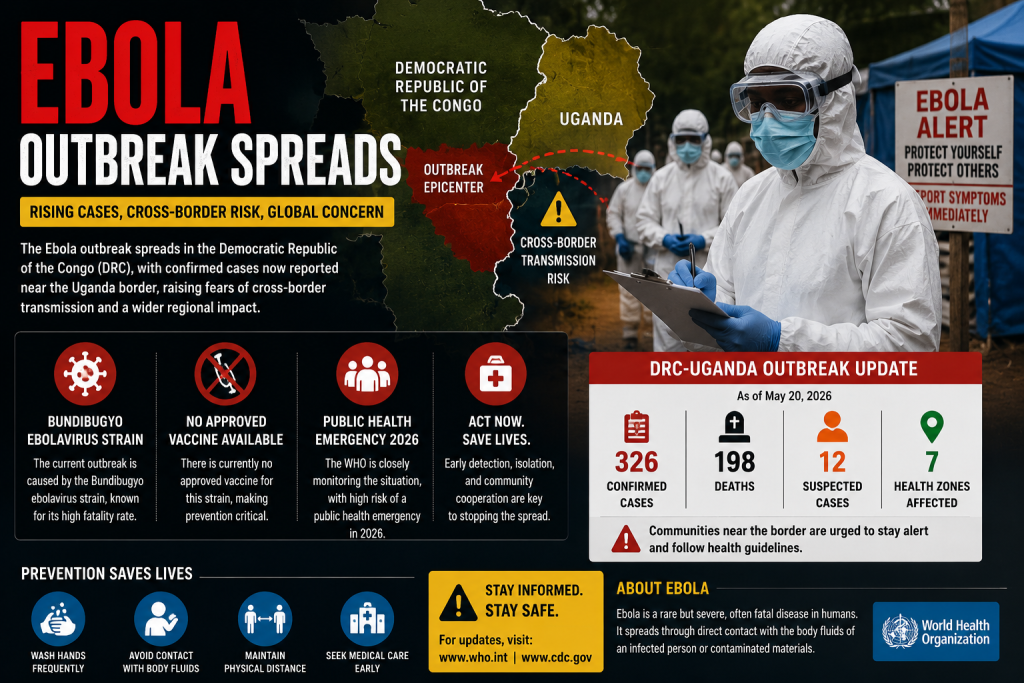
Key facts about this strain include:
- Filovirus family – Bundibugyo ebolavirus is a filamentous (thread-like) RNA virus in the Filoviridae family.
- Discovery – First identified in Uganda in 2007.
- Hemorrhagic fever – Causes severe disease; past Bundibugyo outbreaks saw case-fatality rates around 30–50%.
- Transmission – Spread primarily through direct contact with an infected person’s blood or body fluids (patients are not infectious until symptoms develop); it is not spread through the air.
- Symptoms – Early signs include fever, fatigue, headache and muscle aches, progressing to vomiting, diarrhea, and often unexplained bleeding.
- Reservoir – Fruit bats and primates are suspected natural hosts, but the exact animal source remains unknown.
- Historical fatality – In the 2007 Uganda and 2012 DRC outbreaks of Bundibugyo virus, roughly 30–50% of patients died.
Bundibugyo virus disease (BVD) is extremely dangerous. WHO reports that Bundibugyo outbreaks have historically killed about one-third to one-half of infected patients. Case fatality in the current outbreak (as of late May) is lower (~14% of confirmed cases, but many patients remain hospitalized. CDC emphasizes that early supportive care (rehydration, treating complications) significantly improves survival. WHO also notes that there are no licensed vaccines or specific treatments for Bundibugyo virus, so controlling the outbreak relies on public health measures (isolation, tracing, safe burials) rather than medical cures.
Symptoms and Transmission
Bundibugyo ebolavirus spreads through direct contact with infected bodily fluids or contaminated materials. The virus can infect people who handle the blood, vomit, urine or other fluids of a sick Ebola patient, or who come into contact with infected animals (such as bats or primates). It is not spread through casual contact or airborne routes. WHO confirms that past Bundibugyo outbreaks were amplified by inadequate infection control in healthcare settings and by traditional funeral practices that involve touching the deceased. In other words, nurses, family members, or burial workers without proper protection have often been infected in previous outbreaks.
The incubation period for BVD is typically 2–21 days. During this time an infected person feels normal, but once symptoms begin they usually appear suddenly. Early symptoms – fever, fatigue, headache, muscle pains – are non-specific and resemble malaria or flu. Because early signs are vague, diagnosis requires a high index of suspicion (travel or contact history). Symptoms then progress to severe gastrointestinal distress (nausea, vomiting, diarrhea) and often multi-organ failure. Unexplained bleeding from the gums, nose, eyes or under the skin commonly occurs in the late stages. As of late May 2026, the observed case fatality ratio in DRC was roughly 14% among confirmed cases, which is relatively low for Bundibugyo but could increase. WHO stresses that all known cases have required hospitalization; intensive supportive medical care (fluid management, oxygen, dialysis) improves survival but cannot guarantee recovery.
DRC-Uganda Outbreak Update
Map of the Ebola Bundibugyo outbreak area in Central Africa. The highlighted regions in the Democratic Republic of the Congo (Ituri, North Kivu, and South Kivu) and Uganda show where cases have been reported.
The current outbreak started in northeastern DRC (Ituri Province) and has quickly expanded. On May 15, 2026, laboratory tests confirmed Bundibugyo virus in 8 of 13 samples from Ituri Province. At that time, health authorities were investigating 246 suspected cases and 80 deaths in Ituri. Within hours, two travelers from DRC who arrived in Kampala, Uganda, tested positive for BVD. This sudden jump – including a cross-border infection – prompted WHO to convene an emergency meeting.
Key dates and figures in this DRC-Uganda outbreak include:
- May 5, 2026 – DRC officials report clusters of severe illness in Ituri Province. WHO is alerted to a “high-mortality outbreak of unknown illness.”
- May 15, 2026 – Bundibugyo virus is confirmed in Ituri Province samples; over 200 suspected cases are under investigation.
- May 15–16, 2026 – Two additional cases are confirmed in Kampala, Uganda, in patients who recently traveled from DRC. (One of these Ugandan patients later died in hospital.)
- May 17, 2026 – WHO officially declares the outbreak a Public Health Emergency of International Concern.
- Early June 2026 – Updated case counts: the DRC reports 344 confirmed cases (60 deaths) and 116 suspected cases. Uganda’s Ministry of Health reports 15 confirmed cases (including 1 death).
As of late May, WHO reported that the vast majority of DRC cases were in Ituri Province (102 of 125 cases). North Kivu and South Kivu provinces had a few cases, but intense tracking kept them small. In detail, by 27 May DRC had 125 confirmed cases (17 deaths, ~14% CFR).Uganda had reported 9 cases (1 death) by that time. By 29 May the combined total was 134 confirmed cases (18 deaths).
These figures illustrate a rapidly growing outbreak. DRC’s Ituri Province already faces cholera, measles and polio outbreaks and conflict-related displacement, which strain healthcare infrastructure and complicate the Ebola response. According to WHO’s risk assessment, the outbreak poses very high risk nationally (in DRC) and high risk regionally, but the global risk is considered low.
Uganda Outbreak (May 2026)
The first Ugandan case was confirmed on May 15, 2026 – a Congolese trader who had recently returned from Ituri Province in DRC. This patient developed symptoms in Kampala and later died, marking the first fatal Ebola case outside DRC in this outbreak. Ugandan health authorities immediately traced hundreds of contacts and heightened surveillance at borders. A second related case was confirmed soon after. As of late May, Uganda had reported 9 confirmed cases (including that 1 death). Rapid isolation of patients and careful monitoring of contacts have so far prevented wider spread within Uganda. The Ugandan Ministry of Health continues to update case counts and advises travelers and local communities to remain vigilant.
Cross-Border Transmission Risk
Geography and travel patterns make containment challenging. The epicenter in Ituri Province is a commercial hub bordering Uganda and South Sudan. Heavy movement of people, goods and refugees in this region heightens the cross-border transmission risk. Already, multiple cases have appeared in Uganda among Congolese travelers. WHO notes that neighboring countries sharing borders with DRC (Uganda, South Sudan, Rwanda, Kenya) are at high risk for further spread due to population mobility and trade linkages.
Key factors increasing cross-border risk include:
- Porous borders and mobility – Many communities regularly cross between eastern DRC and neighboring countries for trade or family reasons. This mobility can carry infection quickly across frontiers.
- Healthcare transmission – Several infections have occurred among healthcare workers and in hospital settings in DRC, suggesting that lapses in infection control can amplify spread.
- Travel advisories – CDC has issued a Level 3 travel notice for the affected DRC provinces (avoid nonessential travel) and a Level 1 notice for Uganda (practice usual precautions).
- Screening measures – Authorities in Uganda and neighboring countries have increased health screening at airports and land crossings. Uganda activated health surveillance and exit screening soon after its first case.
Given these risks, continued regional cooperation is essential. Even if cases decline in one country, importation from across the border could reignite the epidemic. Uganda and the DRC, with WHO’s help, are coordinating emergency operations and border measures to reduce this transmission risk.
Public Health Emergency Declaration (2026)
On May 17, 2026, the WHO Director-General declared the Bundibugyo outbreak a Public Health Emergency of International Concern. This rare designation signals that the outbreak is extraordinary and requires global attention. WHO cited the combination of rapidly rising case counts, the detection of cases in Uganda, and high-risk factors in the affected regions as reasons for the decision. WHO explicitly advised against blanket travel or trade restrictions with DRC or Uganda based on current information. Instead, WHO recommended that both countries activate emergency operations centers, enhance laboratory and surveillance capacity, and conduct widespread contact tracing and community engagement. These temporary recommendations aim to strengthen the outbreak response without disrupting vital aid and commerce. In line with WHO guidance, the focus remains on coordinated preparedness and transparent information sharing.
Response and Prevention Measures
Frontline health workers set up an emergency treatment tent during the Ebola Bundibugyo outbreak response in the Democratic Republic of the Congo. WHO and international partners are mounting a large-scale response. Emergency treatment centers and laboratories have been set up to diagnose and treat patients quickly. Healthcare workers are using strict personal protective equipment (PPE) and protocols in Ebola treatment units. International agencies are also building local capacity – for example, CDC reports assisting with expanding laboratory testing and genomic sequencing for Bundibugyo confirmation. Key response activities include:
- Laboratory support – International health agencies are helping expand local lab testing and genome sequencing capacity, so that suspected cases can be confirmed faster.
- Rapid case identification and isolation – Anyone with suspected Ebola symptoms is tested and isolated immediately. Health teams conduct thorough contact tracing to find anyone exposed to confirmed case.
- Infection control in clinics – Hospitals in affected areas have reinforced infection prevention and control measures. WHO guidance emphasizes decontamination, PPE, and safe burial protocols to prevent hospital-based spread.
- Community engagement and safe burials – Local teams are educating communities about Ebola risks and safe practices. Specialized burial teams conduct safe, dignified burials for victims, avoiding traditional funeral rites that often spread the virus.
- International partners – Organizations like the CDC and Médecins Sans Frontières (MSF) are providing on-the-ground support. CDC reports providing technical assistance with surveillance, contact tracing, lab testing, border screening, and IPC training in DRC and Uganda.
- Vaccine development – No vaccine is currently approved for Bundibugyo. However, global health agencies are funding research: CEPI has committed around $60 million to fast-track three candidate Bundibugyo vaccines. WHO and partners are also evaluating any investigational therapies that might be deployed under emergency protocols.
- Travel advice and screening – Screening points have been set up at airports and land crossings. Travelers to affected areas are advised to avoid contact with blood or bodily fluids and to postpone non-essential travel to outbreak zones.
- Supportive care – In the absence of specific antivirals, patients receive intensive supportive care (fluids, electrolytes, oxygen) to improve survival. Early rehydration and symptom management greatly increase the odds of recovery.
These combined efforts aim to slow the spread and protect public health. Community cooperation – such as promptly reporting symptoms, accepting isolation, and adhering to health advisories – remains crucial for controlling the outbreak.
Conclusion and Call to Action
The 2026 Ebola outbreak spreads caused by the Bundibugyo strain is unfolding rapidly along the DRC–Uganda border. With no approved vaccine available and case numbers climbing, vigilance is essential. International agencies and health ministries are working around the clock, but every person has a role: report symptoms early, follow official guidance, and avoid unsafe burial or caregiving practices. Stay informed via WHO and CDC updates, and share this information to help raise awareness. Readers are encouraged to post questions or comments below – engaging the community and spreading accurate information can help protect lives and curb the outbreak.
Frequently Asked Questions (FAQs)
Q: What is Bundibugyo virus disease and how dangerous is it?
A: Bundibugyo virus disease (BVD) is a form of Ebola hemorrhagic fever caused by the Bundibugyo ebolavirus strain. It is rare but often deadly – past Bundibugyo outbreaks had fatality rates around 25–50%. Symptoms include high fever, severe headache, muscle pain, followed by vomiting, diarrhea and bleeding. Early detection and supportive care are critical, as the disease can progress quickly.
Q: Which areas are affected by the current outbreak?
A: The outbreak is centered in northeastern DRC (primarily Ituri Province) and has spread into Uganda. As of early June 2026, DRC has reported over 340 confirmed cases and dozens of deaths across Ituri, North Kivu and South Kivu. Uganda has recorded around 15 confirmed cases (mostly in Kampala) with one death. Authorities caution that the true numbers may rise as surveillance continues.
Q: Is there a vaccine or treatment for the Bundibugyo strain?
A: No approved vaccine is available. Current Ebola vaccines protect against the Zaire strain and are not expected to work for Bundibugyo. Experimental drugs and vaccines are under development, but for now containment relies on intensive supportive care and outbreak control measures. Organizations like CEPI are funding new Bundibugyo vaccine candidates, but none are yet ready for use.
Q: Why was this outbreak declared a global emergency (PHEIC)?
A: WHO declared a PHEIC because the outbreak met criteria for an extraordinary event that could spread internationally. Key factors include rapid spread in multiple provinces, imported cases in Uganda, and uncertainty about how far it had spread. The declaration aims to mobilize the international community for a unified response (it does not imply travel or trade bans).
Q: Has Ebola spread outside Africa?
A: So far, cases have been limited to DRC and Uganda (plus one international volunteer). An American doctor who was working in DRC tested positive and was evacuated to Germany for treatment, but no other countries have reported cases. Public health experts consider the global risk very low at this time.
Q: What is the risk to people outside the outbreak zone?
A: WHO and CDC emphasize that the risk to people outside the affected countries is currently very low. All known cases have been among people in the outbreak region or returning travelers. The disease is not airborne, so only those with very close exposure (e.g. caregivers of the sick) are at significant risk. Travelers should avoid outbreak provinces and follow official advice, but normal activities elsewhere are not restricted.
Q: What precautions should travelers and residents take?
A: Travelers to affected provinces should heed CDC and WHO advisories: avoid travel unless essential, and if traveling practice strict hygiene. People should avoid contact with blood or bodily fluids of any sick person, refrain from attending funerals or touching corpses, and avoid contact with fruit bats or monkeys. Anyone developing symptoms (fever, diarrhea, bleeding) after visiting outbreak areas should seek medical care immediately and mention their travel history.
Share this article and help spread accurate information. Together, we can protect communities and stop the Ebola Bundibugyo outbreak from spreading further.